


The Complete Guide to Livestreaming a High School Commencement Ceremony
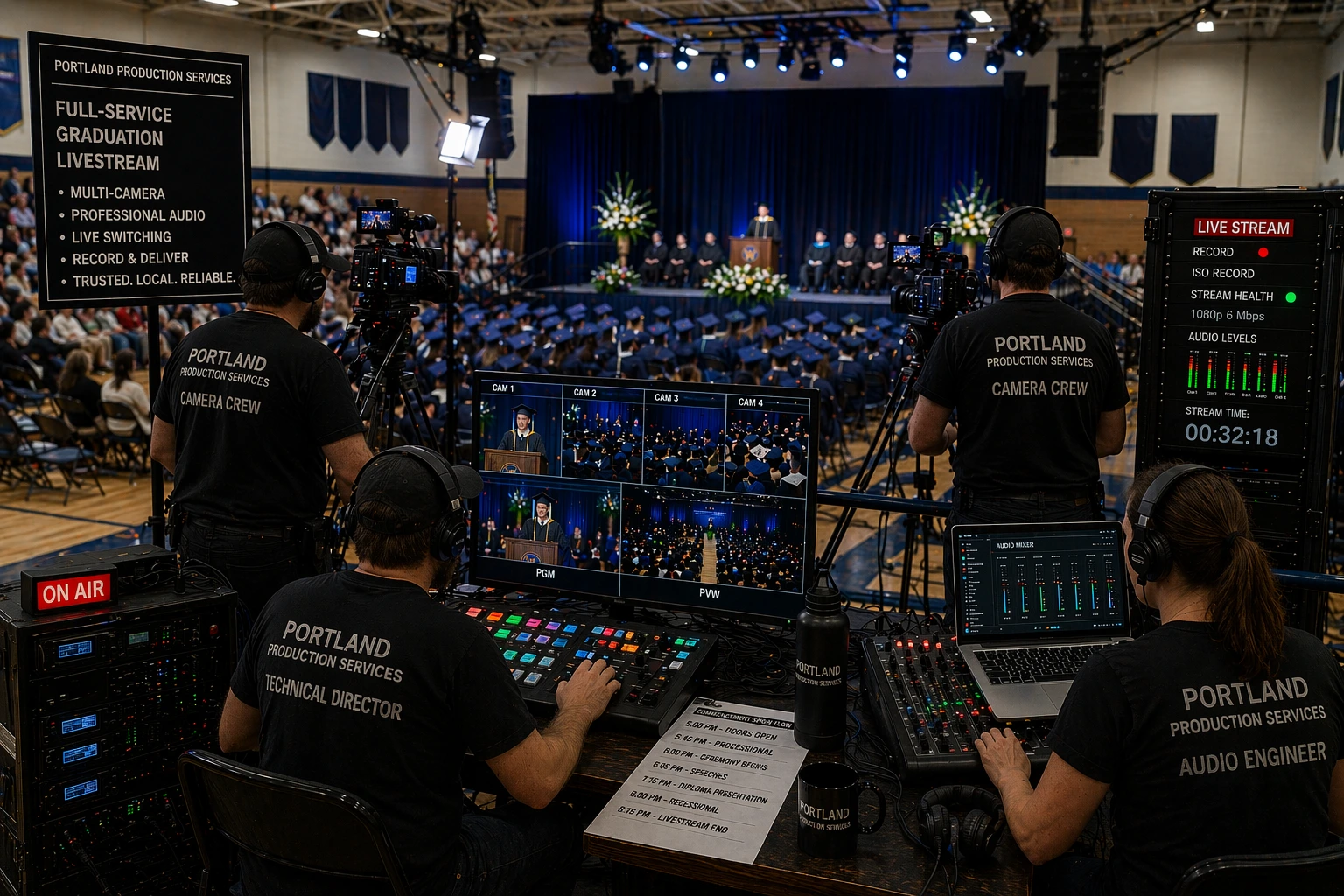
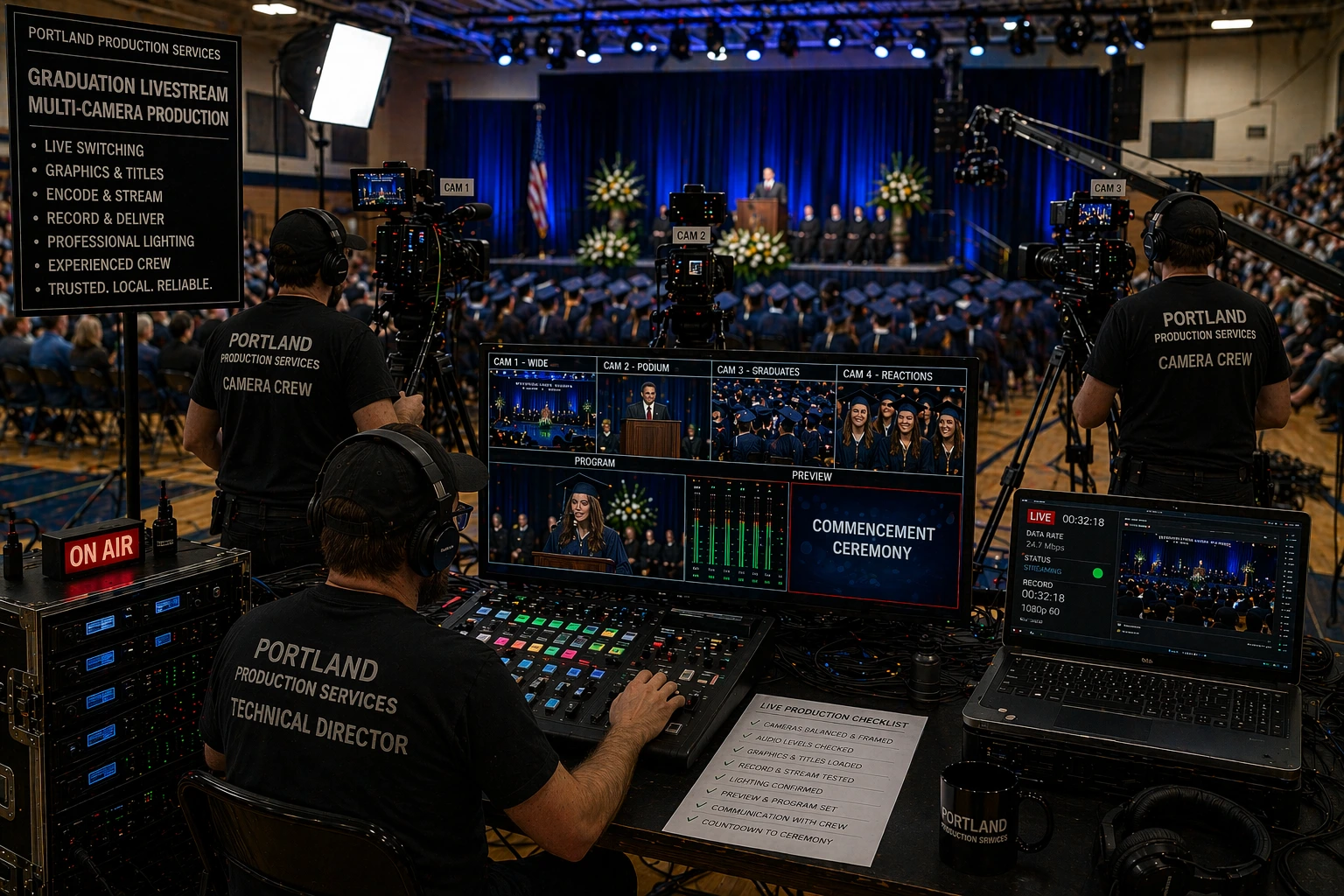
A graduation livestream should guide the viewer, not just record the event. A four-camera setup captures every key moment and creates a smooth, engaging viewing experience.
A graduation livestream done right makes every family feel present, no matter where they are watching. Done wrong, it misses the moments that matter most. Today, livestreaming is no longer optional for schools; it is an essential part of making commencement accessible, inclusive, and meaningful for every student and family. That is why Portland Production Services approaches graduation livestreaming with the planning, equipment, and care needed to deliver a clear, reliable, and professional experience that honors the occasion.
What Is Graduation Livestreaming?
Graduation livestreaming is the real-time broadcast of a commencement ceremony to a remote audience via a streaming platform such as YouTube, Vimeo, or a school's own website. It combines professional video production, broadcast-quality audio, reliable internet infrastructure, and live technical direction to deliver a viewing experience that feels present, not like an afterthought.
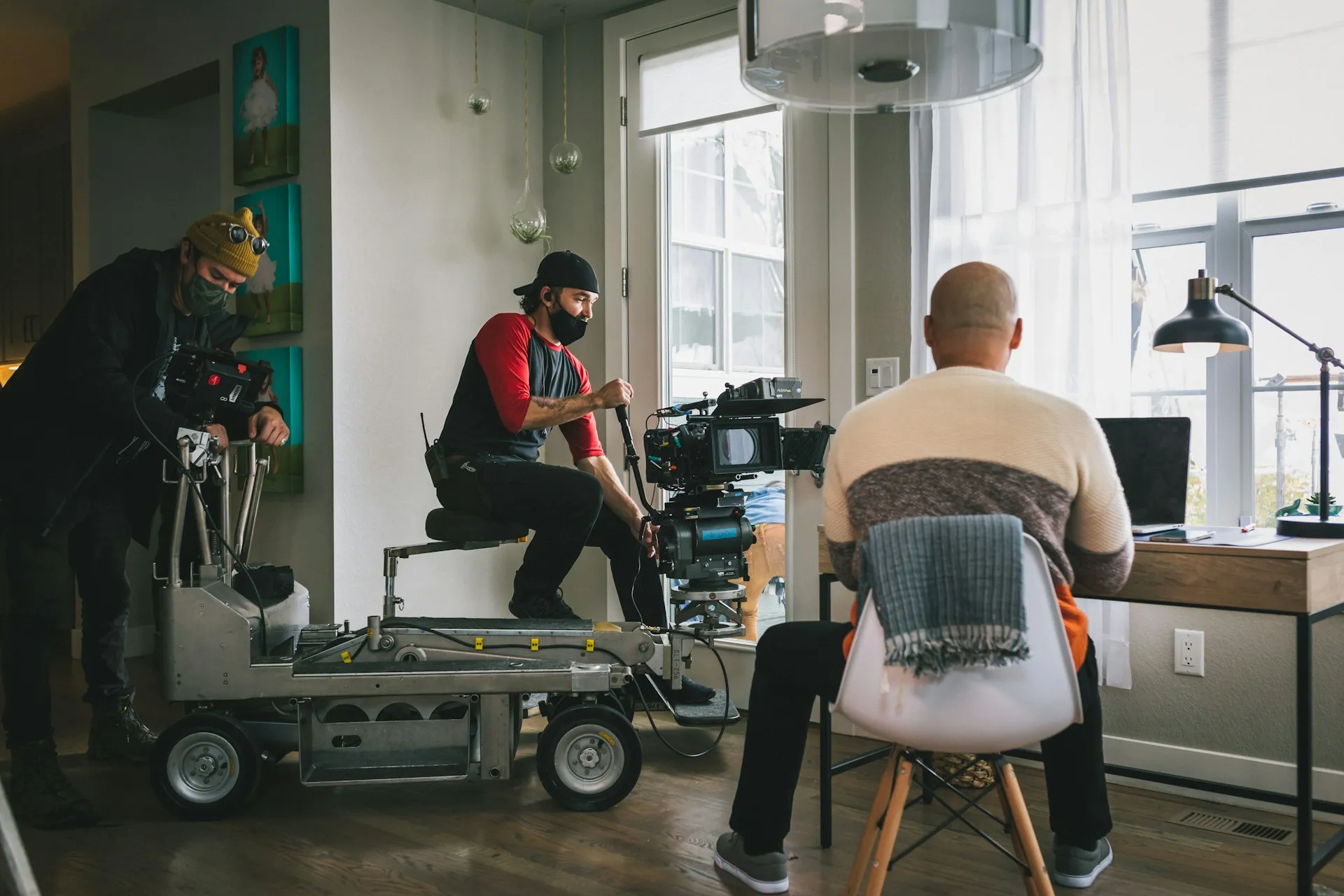
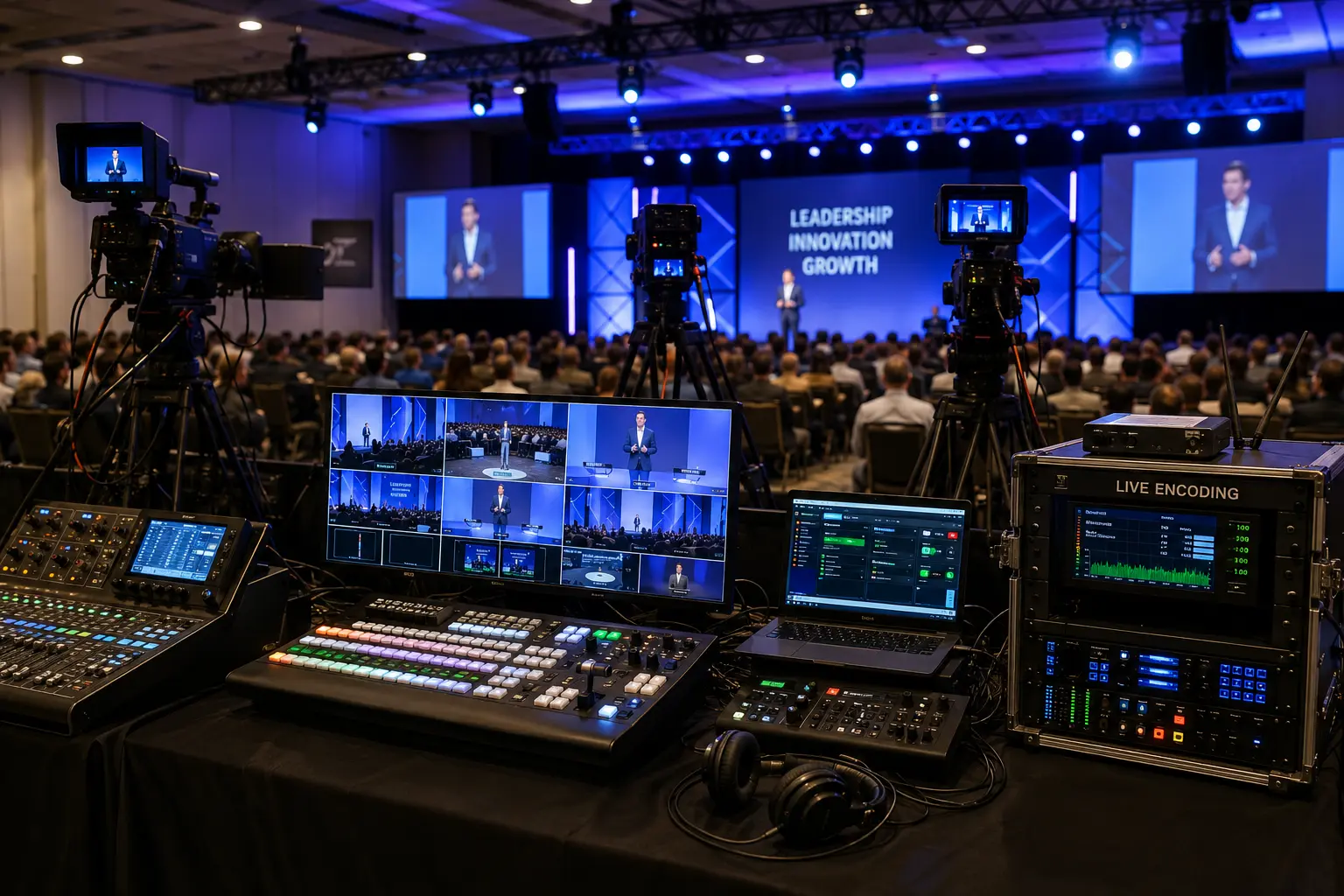
A professional graduation livestream is not a phone on a tripod. It is a multi-camera production with dedicated crew roles, a technical director managing the live feed, an audio engineer balancing multiple microphone sources in real time, and a redundant connectivity setup designed to survive an imperfect venue environment.
The difference between a professional commencement ceremony livestream and a DIY setup is the difference between a family feeling like they were there and a family squinting at a blurry wide shot, straining to hear a name that matters more to them than anything else in that room.
Things to Consider Before Livestreaming a Graduation
Venue
The venue shapes every technical decision in a graduation livestream production. Indoor gymnasiums and auditoriums give you control over lighting consistency and environmental predictability, but they also introduce acoustic challenges: echo, reverberation, and HVAC noise that a poorly placed microphone will pick up and broadcast to every remote viewer.
Outdoor venues offer natural light and visual openness but introduce an entirely different set of risks. Sunlight direction changes throughout the ceremony. Wind affects audio quality. Mobile device usage from hundreds of guests in the same space competes with your internet connection.
Before committing to a production plan, the technical team needs to walk the space. Where can cameras be positioned without blocking sight lines or distracting speakers? Where is power available and how far from the stage? Where is the strongest hardwired internet access point? How does the room sound when it is full? These questions do not have generic answers. They have venue-specific ones.
Equipment
A commencement ceremony livestream is a long, structured, non-pausable event. Equipment that works fine for a thirty-minute meeting will reveal its limitations across a two-hour ceremony. The production setup needs to be reliable, redundant, and purpose-built for the demands of a live event at this scale.
That means professional-grade cameras, broadcast-quality microphones, an audio mixer, a video switcher, streaming hardware, and backup solutions for every single component that cannot fail in front of a live audience. More on each of these below.
Internet Connection
Every graduation livestream depends completely on internet stability. A shared Wi-Fi network in a venue full of guests on their phones is not a reliable streaming infrastructure. A dedicated, hardwired connection tested under realistic load conditions is the baseline for professional commencement production.
Upload speed, network consistency, and latency all affect stream quality. Testing in advance, under conditions that approximate the actual event environment, is not optional. It is the difference between a clean broadcast and a buffering disaster at the moment a family member's name gets called.
Portland Production Services uses a cloud-based live streaming encoder that allows direct streaming to platforms like YouTube even in venues where internet reliability is inconsistent. Backup connectivity options are always part of the production plan.
Camera Setup for a Graduation Livestream
A single wide shot of the stage technically captures a graduation. It does not capture the graduation. The moment a student's name is called, the handshake on stage, the look on a parent's face in the crowd, these are the moments that families tune in to see. A single locked-off wide shot misses all of them.
A proper graduation livestream camera setup typically uses three to four cameras positioned to provide visual variety and capture every meaningful moment.
Camera one: podium and speaker focus. This camera stays locked on whoever is at the microphone. It captures name calls, speeches, and every direct address to the audience.
Camera two: wide stage shot. This is the establishing angle used during processionals, group moments, and diploma presentations. It gives the viewer spatial context for where everything is happening.
Camera three: crowd and reaction coverage. This camera captures the human response: the family section, the student reactions, the moments of emotion that make a graduation feel like what it is.
Camera four: safety camera. A backup wide shot that serves as a fallback angle if any other camera encounters a technical issue or a blocked sight line.
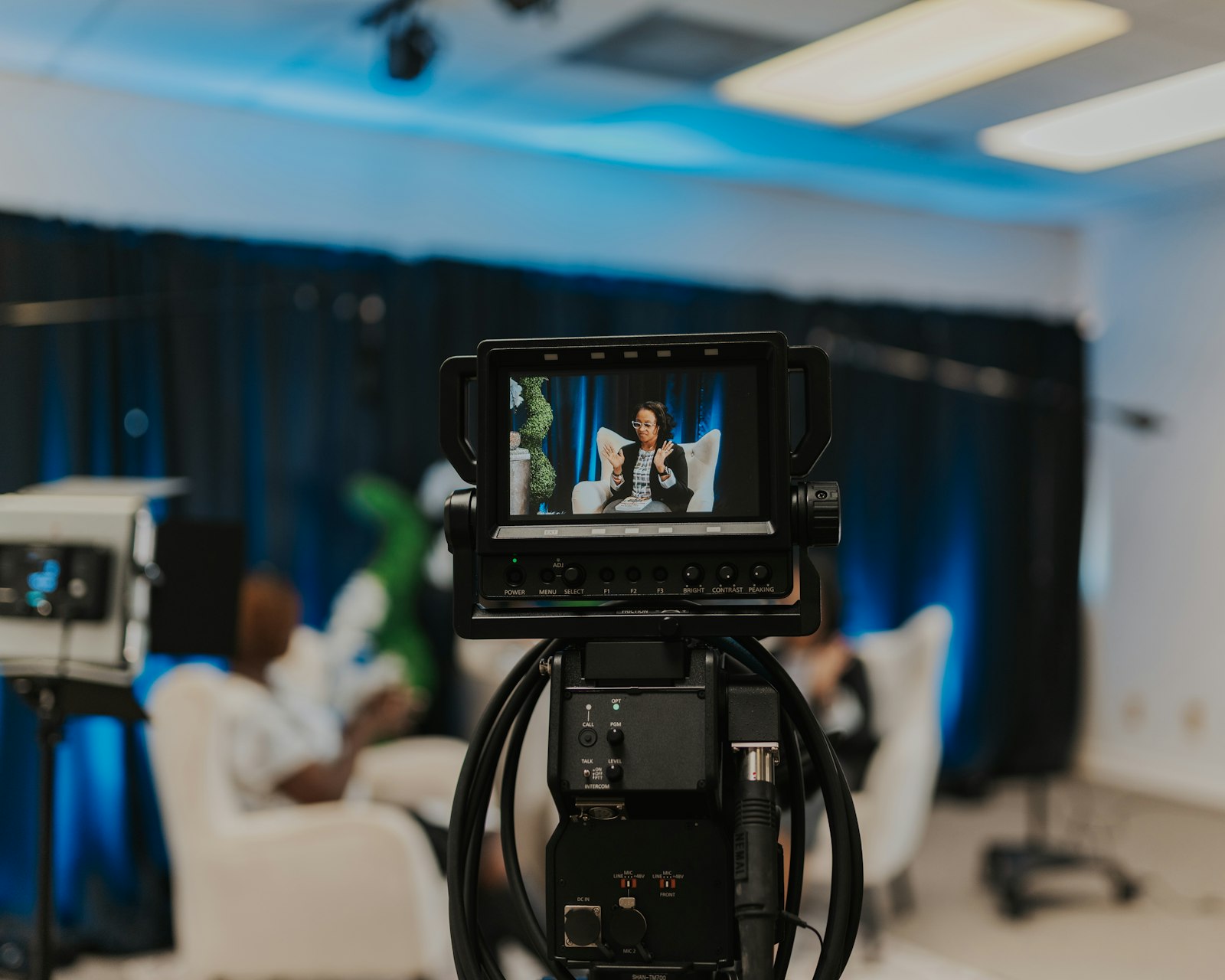
Multiple cameras require a video switcher that allows the technical director to cut between angles in real time, just as a broadcast production would. A multi-camera commencement ceremony livestream without a technical director managing the cuts is just multiple feeds of the same event. With one, it becomes a produced viewing experience.
At Portland Production Services, our Mountainside High School commencement production used exactly this four-camera configuration to give remote families a viewing experience that tracked the ceremony with purpose rather than just recording it from a fixed point. Each angle was intentionally placed to follow key moments from student walk-ins to stage crossings and audience reactions ensuring nothing felt missed or disconnected. This approach transforms a standard graduation livestream into a polished, broadcast-level experience that keeps viewers engaged from start to finish.
Audio Setup for a Graduation Livestream
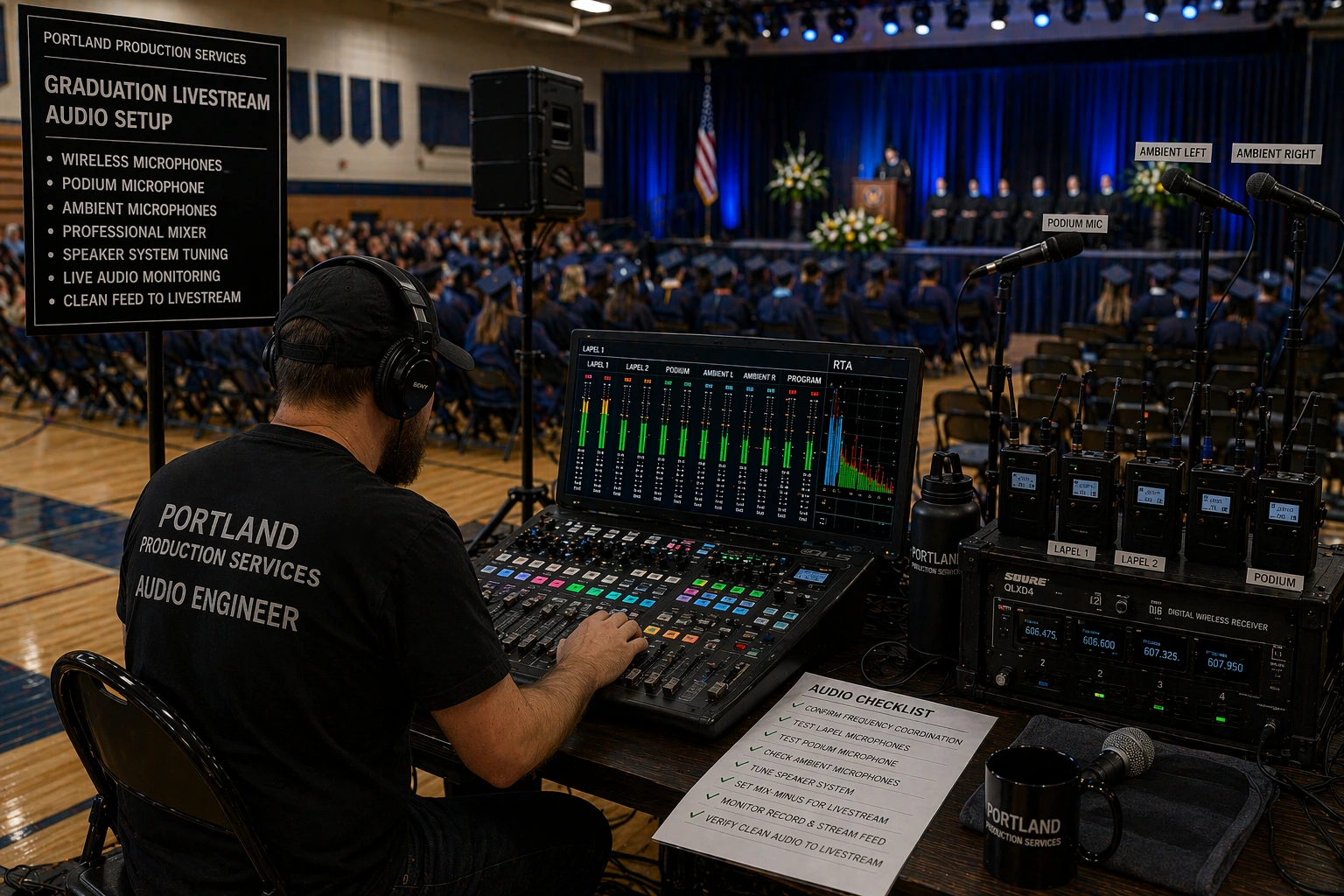
Audio is the most emotionally critical element of any graduation livestream and the element most likely to be underestimated. Every remote viewer is waiting for one specific moment: the moment their person's name is called. If that moment is muffled, distorted, or buried under room noise, the entire production has failed the family it was supposed to serve.
Microphone selection depends on the event format. Podium microphones handle primary speaker audio. Handheld microphones are used for presenters and award readers who move around the stage. Lavalier microphones can be used for specific roles where a hands-free solution is required. The right combination depends on the ceremony structure and the planning committee's specific needs.
Speaker placement is equally important. Speakers positioned and angled incorrectly create echo, feedback, and uneven coverage that makes in-room audio muddy and livestream audio unusable. Thoughtful placement ensures the entire venue hears clearly while minimizing the acoustic reflections that cause problems for microphones.
The audio mixer ties everything together. It allows the audio engineer to balance levels across every microphone source in real time, adjust for a soft-spoken presenter, pull back when the crowd applause peaks, and blend background music with live audio without either element overwhelming the other.
At Portland Production Services, our Mountainside graduation production used RCF 6-inch cone speakers positioned and angled specifically to distribute sound evenly across the gymnasium while minimizing bounce. QLXD microphones and X Air mixers handled the microphone and mixing needs. The result was clear, consistent audio from the first name to the last.
Internet and Streaming Infrastructure
A graduation livestream is only as reliable as the connection delivering it. The most professionally produced ceremony in the world goes nowhere if the stream drops five minutes into the diploma presentation.
Hardwired connections are strongly preferred over wireless for any production-critical stream. A dedicated ethernet connection that is not shared with the venue's general guest network provides the consistency that a multi-hour broadcast requires.
Upload speed testing under realistic conditions is a non-negotiable pre-production step. The venue's connection on a Tuesday afternoon may look very different from what is available on graduation day when every guest is streaming the ceremony on their phone.
Redundant connectivity means having a backup pathway ready if the primary connection encounters issues. Portland Production Services equips every commencement ceremony livestream production with backup hardware connections and redundant streaming pathways so that connectivity problems get resolved quietly in the production booth rather than visibly on the audience's screen.
Platform scheduling matters for distribution. Scheduling the livestream on YouTube in advance allows school administrators to share the event link with families ahead of time, removing the logistical confusion of a last-minute URL distribution on the day of the ceremony.
Technical Rehearsals
A full technical rehearsal is not optional for professional graduation livestream production. It is the single most important thing a production team can do to protect the integrity of the event.
A proper rehearsal tests every camera angle and confirms sight lines. It verifies audio levels across all microphone positions. It coordinates speaker order and transitions with the ceremony program. It confirms stream settings and platform delivery. And it reveals the logistical constraints and environmental variables that no walkthrough or floor plan can fully anticipate.
At Portland Production Services, the technical rehearsal is where most potential problems are identified and resolved before they ever have a chance to become live-event problems. The ceremony deserves that preparation.
Backup Plans and Contingency Strategy
Every commencement ceremony livestream carries the inherent unpredictability of a live event. Professional production teams do not hope for the best. They plan specifically for what can go wrong and prepare the response before it is needed.
Spare cameras for equipment failures. Redundant audio feeds in case a microphone goes down. Additional cables and adapters for unexpected connection failures. Backup streaming hardware if the primary encoder encounters an issue. Contingency connectivity if the primary internet connection degrades.
Portland Production Services equips every graduation livestream production with wireless systems as the primary approach and hardwired backup connections as the fallback, with redundant pathways confirmed before the ceremony begins. Problems that are anticipated and prepared for do not become visible ones.
Livestreaming Is Not a One-Person Job
This is one of the most important things a school administrator can understand before contracting a graduation livestreaming service: a properly produced commencement ceremony livestream requires a team, not a multi-tasker.
A technical director manages the live stream and makes real-time switching decisions. Camera operators focus entirely on their assigned angles and shot responsibilities. An audio engineer monitors and adjusts audio levels throughout the event. Each role exists because each responsibility requires focused, undivided attention. When one person tries to handle all of them simultaneously, the quality of every role suffers, and the failures happen publicly.
When Portland Production Services shows up to a graduation production, an actual production team shows up. Not one person with a lot of equipment and good intentions.
Field Notes: Mountainside High School Commencement
Portland Production Services was honored to provide graduation livestreaming services for Mountainside High School's commencement ceremony. The production used a four-camera configuration: a dedicated podium camera, a crowd coverage camera, a wide stage shot camera, and a safety backup camera. The multi-camera setup provided the visual variety that makes a two-hour ceremony watchable for remote audiences rather than exhausting.
For audio, RCF 6-inch cone speakers were positioned throughout the gymnasium, angled to achieve even coverage across the space while minimizing sound bounce. QLXD wireless microphones and X Air mixers handled all microphone and mixing requirements, delivering clear, consistent audio from the first speaker through the final diploma presentation.
The livestream was scheduled on YouTube in advance, allowing the school to share the link with families before the event and eliminating any last-minute distribution confusion.
Every Family Deserves to Be There
Graduation livestreaming is not a technical service. It is a commitment to inclusion. It is the decision to make sure that every parent, grandparent, sibling, and friend who could not be in that gymnasium still gets to be present for the moment that matters most to the student they love.
Portland Production Services approaches every commencement ceremony livestream with that understanding. From the planning conversation and technical rehearsal through execution and redundancy management, the goal is not just a functioning stream. It is a viewing experience that does justice to the ceremony and the people watching it.
Portland Production Services brings over twenty years of professional production experience, fully owned equipment, and a team-based approach to every graduation livestream. When this moment cannot be redone, you want a team that has done it before.
Ready to Plan Your Commencement Ceremony Livestream?
Graduation day comes once. Portland Production Services produces graduation livestreams that make sure every family feels present, no matter where they are watching from. Get in touch to start planning your commencement production.
Frequently Ask Questions
1: What does a professional graduation livestream include?
A professional graduation livestream includes multi-camera production coverage, broadcast-quality audio with a live audio engineer, a technical director managing the live feed, a video switcher for real-time camera cuts, dedicated internet infrastructure, redundant backup systems, a technical rehearsal, and post-event recording. It is a full production operation, not a single camera on a tripod.
2: How many cameras are needed for a commencement ceremony livestream?
Most professional commencement ceremony livestream productions use three to four cameras. A podium camera, a wide stage shot, a crowd coverage camera, and a safety backup camera represent the standard configuration. This setup provides the visual variety needed to make a multi-hour ceremony engaging for remote viewers and covers every moment that families are waiting to see.
3: What internet setup is required for a graduation livestream?
A dedicated, hardwired internet connection is strongly preferred over shared venue Wi-Fi for any graduation livestream. Upload speed and network consistency should be tested under realistic conditions before the event. Portland Production Services uses a cloud-based streaming encoder that maintains broadcast stability even in venues where internet reliability is inconsistent, and always prepares redundant connectivity as a backup.
4: How early should we start planning a graduation livestream?
The earlier the better. Technical rehearsals, venue walkthroughs, platform scheduling, equipment logistics, and crew coordination all require lead time. For a commencement ceremony, starting the production planning conversation at least four to six weeks before the event allows for proper preparation without compressing any phase of the process.
5: Can Portland Production Services livestream to YouTube?
Yes. Portland Production Services regularly schedules graduation livestreams directly to YouTube, which makes it easy for schools to share a single link with families in advance of the event. The team uses a cloud-based encoder that supports direct platform delivery even in venues with inconsistent internet infrastructure.
6: What makes Portland Production Services the right choice for graduation livestreaming?
Over twenty years of professional event production experience, a team-based approach where every crew role is filled by a dedicated specialist, fully owned production equipment with no rental dependencies, redundant backup systems for every critical component, and a track record of commencement productions like the Mountainside High School ceremony. When graduation day cannot be repeated, you need a team that has done this before and knows exactly what it requires.
Key Takeaways
- A professional graduation livestream is a multi-camera, team-produced live broadcast, not a single-operator setup. Every role requires dedicated focus.
- Venue walkthrough, internet testing, and technical rehearsal are non-negotiable pre-production steps that determine whether the event runs cleanly or encounters visible problems.
- Audio quality is the most emotionally critical element of any commencement ceremony livestream. The moment a name is called, every remote viewer is listening. That moment cannot afford to be muffled or distorted.
- Redundancy in equipment, audio feeds, and internet connectivity is what separates professional production from amateur setups that hope for the best.
- Portland Production Services brings experienced teams, owned gear, and twenty-plus years of live event production to every graduation livestream it produces.
There's more ...
Unleash Your Inner Creative Madness With Us!
info@portlandproductionservices.com
503-317-6447
© Portland Production Services 2026
8816 SE 29TH AVE
MILWAUKIE OR 97222-6323, US

